Tuesday, August 13, 2013

Terrestrial Orchids with Don Fisher

The rain did nothing to dampen our enthusiasm for viewing the splendid display of orchids and other blooming wildflowers as Don Fisher led us around the grounds of Coweeta Hydrologic Lab.  Don did an amazing job of scouting out these illusive orchids and conducting us through the areas where we could see the treasures.

The Orchids we were hoping to see included Three Bird (Triphora trianthophora), Rattlesnake Plantain (Goodyera pubescens), Green Wood Orchid (Platanthera clavellata),  Leaves of pink ladies slipper (Cypripedium acaule), Crane fly (Tipularia discolor), Slender ladies tresses (Spiranthes gracilis), and Yellow Fringed Orchid (Platanthera ciliaris (L.) Lindl.).

We were treated to the sight of the very rare Three Bird Orchid (Triphora trianthophora) or Nodding Pagonia right at the start!  This was such a treat because it is so small and inconspicuous that it's extremely easy to miss so it takes someone with an expert eye, like Don, to even notice them.  It only blooms for one day so you most often see either the bud unopened or the spent bloom.  It's usually no taller than 8 inches in height and likes acid soil, particularly hemlock forest.  It gets it's name from the fact that when it's in bloom, it looks like three tiny birds have their mouths open for food or it resembles three birds in flight--I've heard it described both ways.  I'm guessing a birder was involved with the naming of this orchid?  There's a great article here HERE and another one HERE if you want to read more about it.


Three Bird Orchid by Karen Lawrence

Three Bird Orchid Photo by Karen Lawrence

From there we were fortunate to view examples of all of the orchids on our list!  The moist woods was the habitat for the Rattlesnake plantain, the Green wood,  Crane Fly and the leaves of the pink ladies slipper.

Downy Rattlesnake Plaintain; Goodyera pubescens
The triangular spike of flowers is tightly pack on top third of stem.  Flowers are small and rounded.  This orchid is the most prolific we have in the southern mountains and can be found in virtually every habitat.  There is a network of markings on each leaf which resembles the network of scales on the head of the rattlesnake.  
Green Woodland Orchid;  Plantanthera clavellata Also called Club Spur Orchid
Club spur refers to the swollen or enlarged tip of the spur of each flower.  The slender backward extension of the lip is often referred to as the nectary.  The flowers are small and rounded and often oriented in different directions.  This orchid is often inconspicuous because of green color and slender appearance which blends with background.  It can reach up to about 10" in height.  It usually displays only one narrow leaf partway up stem.  It can be found in wet areas of open fields or woods.  It blooms about the same time at the Diana fritillary butterfly begins to be seen on thistles.  

Cranefly; Tipularia discolor-
So named because individual flower somewhat resembles the cranefly.  Individual flowers have a long slender spur.  A solitary leaf which appears in the winter is dark green on top and bright purple or beet red on bottom.  The leaf is not present during flowering.  They bloom in summer in dark woods and often go undetected.  There are three species of this genus in the world, yet only one occurs in North America.  It often has a preference for woods with beech trees.


The nearby roadway was the site of the slender ladies tresses and a magnificent grouping of the yellow fringed orchid which happens to be my most favorite!  it is truly an awesome display and visible from your car!  I took a friend out there Saturday and we were able to view them easily from the car without disturbing a single blade of grass.

Slender Ladies Tresses; Spiranthes lacera photo by KL
Plant has a green lip marginally edged with white.  The scientific name refers to the small lacerations on edge of lip and to the spiraling pattern of flowers as they ascend the stem.  This pattern is reminiscent of braided hair. Basal leaves may be absent at flowers.  This is the second largest genus of orchids in our mountains, second to the fringed orchids-Plantanthera.
Yellow Fringed Orchid; Plantanthera ciliaris by Karen Lawrence
Some refer to this as orange fringed orchid due to its appearance.  It is fairly common in our southern mountains in early to mid August but is susceptible to even small habitat changes.  Look for it in open sunlight in somewhat damp conditions or even dry sand.  Most healthy plants reach heights up to 15".  Most flowers open from the bottom up.  
In addition to the orchids, we also saw the following:
Everlasting pea which was grown by Thomas Jefferson at Monticello back in 1807, Sumac, Virgin's Bower, Boneset, Fleabane, Sundrops, Coreopsis, Brown Nut, Colic Root, Rose Pinks and meadow beauties.


button rosy

Colic Root
Hairy Woodland Sunflower.  Can anyone identify the butterfly?  


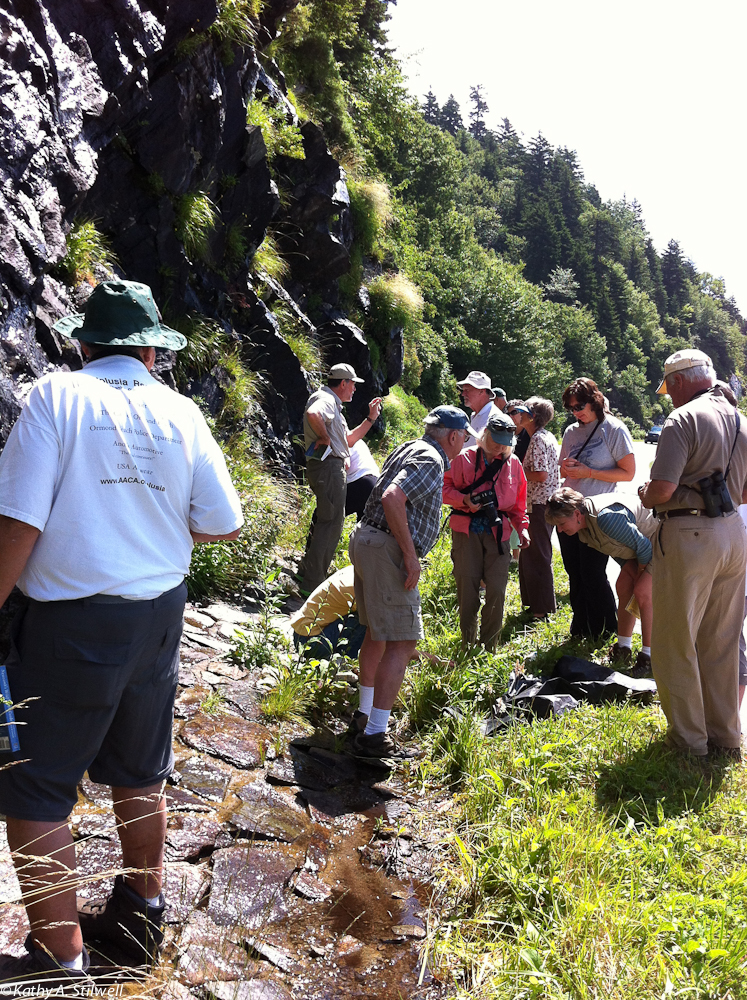
Looking at Three Bird Orchid


It was very tiny


Compiled by Kathy Stilwell 

Saturday, July 27, 2013

Wolf Mountain and the Blue Ridge Parkway with Karen Lawrence and Newcomb's Wildflower Guide


compiled by Kathy Stilwell with Jean Hunnicutt and Dan Rawlins  Photos by Karen Lawrence with contributions by Ned Kraft


After so many days of rain, we were especially fortunate to have splendid weather for our trip to Wolf Mountain along the Blue Ridge Parkway led by the very knowledgeable Karen Lawrence with her trusty Newcomb’s Guidebook at her side and her ever present Nikon around her neck.  Having Dan Rawlins along to share his vast expertise was a major bonus as was the presence of Bob Gilbert, plantsman supreme!  A special thanks to Jean Hunnicutt for her superb skills of keeping track and noting what we encountered.
Photo by Jean Hunnicutt

Our five car caravan stopped shortly after we entered the parkway.  We used Newton’s keys to attempt to identify a number of plants along the roadside.  With some, we were successful; with others, not so much.  We learned any number of the intricate elements of describing flowers and stems and leaves and the way leaves grow and the way flowers grow.  We learned about radial and non radial growth patterns of flowers and how to classify flowers by the number of parts unless they are irregular or indistinguishable.  We learned about the plant type--does it have basal or alternate or opposite or whorled leaves or no leaves?  And we learned about leaf types.  Are they entire or toothed or lobed or divided.   We learned that when in doubt, divided trumps toothed!  I’m telling you, the number of minute variations was breathtaking and mind-boggling.  Add to that, the amazing number of varieties and you find yourself in a wildflower dreamland.  

Our next stop was the Rock Face at the Wolf Mountain Overlook which is an incredibly unique plant environment--one I would love to duplicate at my home!  We ended the excursion on just the right note with a superb lunch at Pisgah Inn.  We were reminded once again about how privileged we are to live in such close proximity to such “gracious plenty”.  (That’s a term I heard just recently and I love it.) 

Following is the list of species we encountered with some photos from the day.  Enjoy!

End of entry ramp BRP
Heal-all                                                Prunella vulgaris
Spikenard                                            Aralia racemosa
Short-styled Snakeroot                       Sanicula canadensis
Black Snakeroot/ Black Cohosh          Actaea racemosa
Common Greenbrier                            Smilax rotundifolia
Flowering Spurge                               Euphorbia corollata
Heart-leaved Skullcap                         Scutellaria ovata
Thimbleweed                                       Anemone virginiana

Riding along the Parkway
Turk’s-cap Lily                                     Lilium superbum
Phlox (Downyand/or Smooth)              Phlox pilosa
Crimson Bee Balm/ Oswego Tea        Monarda didyma


Rock Face Across from Wolf Mt Overlook
Bush Honeysuckle                              Diervilla lonicera
Michaux’s Saxifrage                           Saxifraga Michauxii
Long-leaved Houstonia                       Houstonia longifolia
Thyme-leaved Bluets                          Houstonia serpyllifolia
Mountain St. John’s Wort                    Hypericum graveolens
Appalachian St. John’s Wort               Hypericum buckleyi
(other St John’s Worts)
Grass-of-Parnassus                           Parnassia asarifolia
False Dandelion                                   Krigia Montana
Sundew                                              Drosera rotundifolia

False Asphodel                                   Tofieldia glutinosa
Water Hemlock                                    Cicuta bulbifera
Green-headed Coneflower                 Rudbeckia laciniata
Small Green Wood Orchid                   Habenaria clavellata
Joe-Pye Weed                                    Eupatorium --several species

Also:  
A couple of species of mountain mints and some basil-balm. We also saw both pale and spotted jewelweed, native clematis (in and around the greenbrier), and some immature turtleheads.

Buckleyi St. John's Wort

Green Wood Orchis--by Karen Lawrence

Downy Skullcap  (Scutellaria incana) by KL

Mini-Community on rock wall by Karen Lawrence

Sticky Asphodel (Tofieldia gultinosa)
Grass-of-Parnassus (Parnassia asarifolia Ventenat)by JH
Flowering Spurge (Euphorbia corollata Linnaeus) by JH
Thimbleweed (Anemone virginiana L.) by JH
Bush Honeysuckle (Diervilla sessilifolia Buckley) by JH

Sticky Asphodel Group by Karen Lawrence
Sundew (Drosera rotundifolia)


Karen and I decided to retrace our steps the Friday following our trip.  We were in search of the Larkspur that was said to be blooming near the entry ramp.  Here are some photos from that excursion.
Tall Bellflower (Campanula americana) KL

Flowering Spurge (Euphorbia corollata) KL

Thimbleweed (Anemone virginiana) KL

Tall Larkspur (Delphinium exaltatum) KL

Sundew (Drosera rotundifolia) by Karen Lawrence

St. John's Wort (one of many varieties) by Karen Lawrence

Pale Jewelweed (Impatiens pallida) By Karen Lawrence
by Ned Kraft

By Ned Kraft

by Ned Kraft

By Ned Kraft


Thursday, June 27, 2013

Trip to Fires Creek in search of the Mountain Camellia (Stewartia ovata) with Jack Johnston by Jean Hunnicutt with photos by Karen Lawrence


June 20, 2013

The Fires Creek trip had its ups and downs (pun intended).

Jack had warned us the Stewartias might not be in bloom.  They almost always bloom on the summer solstice, but nearly everything has bloomed late this year.  Sure enough, we saw only buds.
There were logistical challenges:  
  • A bridge out near the entrance to the park caused a long detour/rerouting.  
  • The creek was more swift than usual and not appropriate for the "wading" we'd expected.  Many in the group did make the first crossing but other crossings were too swift.  
  • There were also the challenges of how to shuttle people in a limited number of cars to move us to trails where we might access Stewartias without crossing the creek.

Through it all, Jack remained calm and organized and told us about Stewartias.

They are named for the Earl of Stuart, friend of King George III (never mind the spelling).
Members of the Tea family, there are 2 Stewartias native to the US:  
  • Stewartia malacodendron, Silky Camellia which occurs mainly on the coastal plain but is hardy in our area.
  • Stewartia ovata, Mountain Camellia which occurs mainly in the Appalachians and Piedmont.
Other Stewartias:  1 Korean, 2 Japanese, 3 Chinese.
Relatives are Franklinia, Gordonia and a hybrid of the two called Gordlinia.

Seeds take 2 to 3 years to germinate, and growth during the first year is only about 2 inches.

Jack thinks the root systems of some Stewartia may be as much 500 years old.  New sprouts could live for 80 to 100 years, to be replaced by newer ones.
The largest grow on stream banks which provide moisture and gaps in the tree canopy to let in light.  Rocky bluffs also provide canopy gap for light and are good habitat for Stewartias. Trees that like the same conditions are maple, sourwood, pine and rhododendron.

As Karen’s photos show, the leaves are not very distinct.  They are very hard to distinguish among other trees. The ridged, furrowed bark is more distinct. But it’s the beautiful blooms that really set them apart.

Jack is passionate about Stewartias, and his passion is infectious.  We all had a wonderful day and gained a new appreciation of our Mountain Camellia.  I vote that we plan another trip next year – on the summer solstice.

A final note:  Jack’s Virginia friends are hunters of Champion (i.e. largest) Trees.  While they were in our area, they identified 14 new Champions – including a Stewartia Ovata at Fires Creek!